
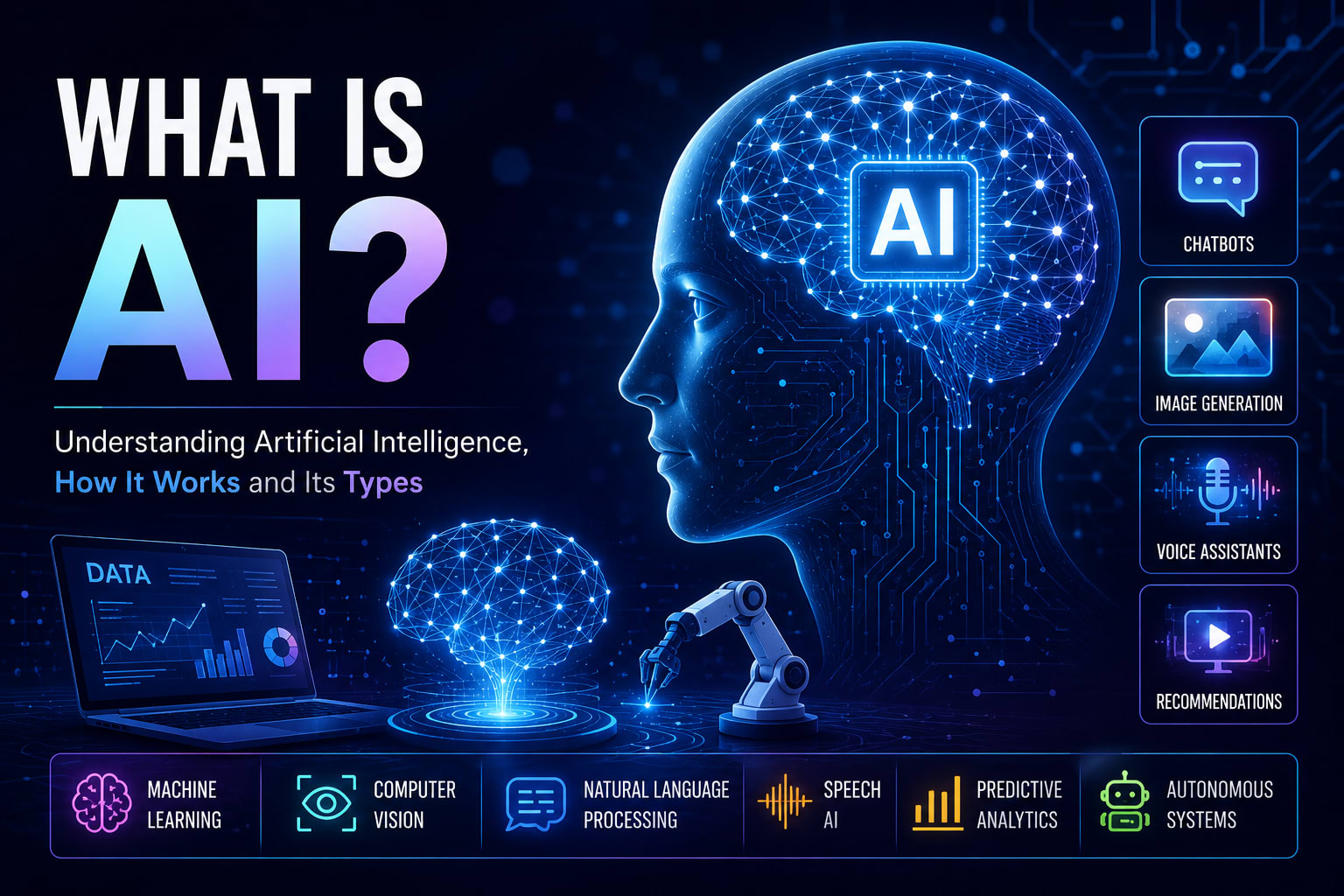
AI stands for Artificial Intelligence. It is basically a brain-like system that works in a way similar to the human brain. Humans learn from what they see, hear, experience, and from the mistakes they make. We get feedback from our environment and society, and we improve over time.
In a similar way, AI learns from data. It analyzes large amounts of information, finds patterns, and then uses those patterns to make decisions, generate answers, and respond to new situations.
AI can perform tasks that normally require human intelligence, such as:
- Understanding language
- Recognizing images, speech, and patterns
- Learning from data
- Solving problems
- Making decisions
- Generating text, images, music, or code
Examples of AI#
We use AI in our daily lives without even noticing it. Some common examples are:
- Voice assistants like Siri and Google Assistant
- Recommendation systems on Netflix and YouTube
- Chatbots like ChatGPT
How AI Works
AI needs a large amount of data to learn. During training, it analyzes the data and finds patterns and relationships between different pieces of information.
When a new input is provided, AI compares it with the patterns it has learned and then predicts the most suitable response or action.
Simple Process#
- Collect data
- Train the AI model
- Find patterns in the data
- Receive new input
- Make predictions
- Generate a response
Types of AI
1. Generative AI#
Generative AI creates new content such as text, images, videos, music, or code.
Examples#
- ChatGPT (Text, Code)
- Google Gemini (Text, Images)
- Midjourney (Images)
- Claude (Text)
Uses#
- Content creation
- Chatbots
- Image generation
- Coding assistance
2. Predictive AI#
Predictive AI analyzes historical data to predict future outcomes.
Examples#
- Weather forecasting
- Stock price prediction
- Sales forecasting
- Fraud detection
Uses#
- Business analytics
- Risk assessment
- Demand forecasting
3. Conversational AI#
Conversational AI is designed to interact with humans using natural language.
Examples#
- Chatbots
- Virtual assistants
- Customer support systems
Uses#
- Customer service
- Personal assistants
- Help desks
4. Computer Vision AI#
Computer Vision enables computers to understand and analyze images and videos.
Examples#
- Face recognition
- Medical image analysis
- Self-driving car vision systems
Uses#
- Security
- Healthcare
- Manufacturing
5. Natural Language Processing (NLP) AI#
NLP focuses on understanding and generating human language.
Examples#
- Translation
- Sentiment analysis
- Text summarization
Uses#
- Search engines
- Translation apps
- Document analysis
6. Speech AI#
Speech AI works with spoken language.
Examples#
- Speech-to-text
- Text-to-speech
- Voice assistants
Uses#
- Voice commands
- Call centers
- Accessibility tools
7. Recommendation AI#
Recommendation AI suggests products, videos, music, or content based on user behavior and preferences.
Examples#
- YouTube recommendations
- Netflix recommendations
- Amazon product suggestions
Uses#
- E-commerce
- Streaming platforms
- Social media
8. Autonomous AI#
Autonomous AI can make decisions and perform tasks with minimal human intervention.
Examples#
- Self-driving cars
- Delivery robots
- Industrial robots
Uses#
- Transportation
- Logistics
- Manufacturing
Conclusion
Artificial Intelligence is one of the most important technologies of the modern world. Just like humans learn from experience, AI learns from data. It can understand information, recognize patterns, make predictions, and even create new content. Today, AI is used in many areas such as healthcare, education, business, entertainment, transportation, and software development, making our lives easier and more efficient.
